



Lavrenti Beria, Josef Stalin’s sinister political police chief, left a phrase for posterity that encapsulates totalitarian regimes: “Show me the man, and I’ll tell you the crime.” In the Soviet Union, the justice system was merely an instrument of dictatorship. Courts functioned as stages for predetermined convictions. First, the enemy was chosen, then the offense was fabricated. Extrajudicial commissions, known as ‘troikas,’ decided the fate of thousands in minutes.
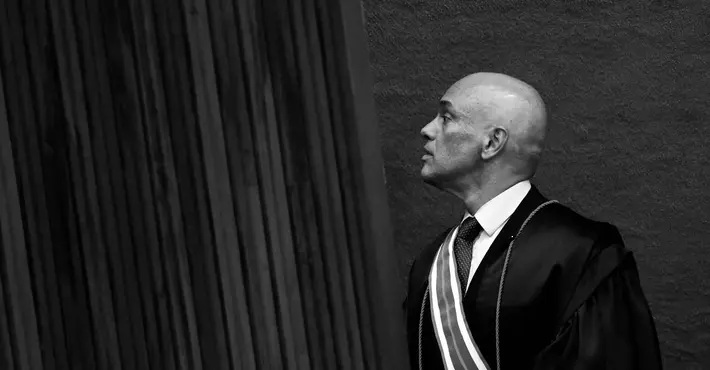
Today, Brazil rekindles this perverse logic. The Supreme Federal Court (STF), under the baton of justice Alexandre de Moraes, has transformed into an inquisitorial machine. All that’s needed is to point to a target, and his subordinates will take charge of producing reports, certifications, dossiers, and ‘legal’ foundations to secure a conviction.
Receba nossas atualizações
What is ‘Vaza Toga’?
It was in this scenario that the ‘Vaza Toga’ investigative series emerged, exposing the workings of this new court of exception. The publications reveal how advisors, auxiliary judges, and technical staff from the STF and Superior Electoral Court (TSE) participated in a clandestine apparatus of censorship and persecution. What is evident is the existence of a shadow cabinet, headed by Moraes, which has transformed civil servants from the country’s main courts into agents of an unofficial political police. The now-public documents reveal orders transmitted via WhatsApp, reports fabricated on demand, and decisions made outside legal procedure. The roles of investigator, accuser, and judge are deliberately mixed up and played by a single justice.
One of the most scandalous episodes occurred in December 2022 and came to light in August 2024, in reports published by Folha de S. Paulo. At the time, the newspaper revealed that judge Airton Vieira, an advisor to Moraes at the STF, sent a message to the then head of the Special Advisory for Combating Disinformation at the TSE, Eduardo Tagliaferro, demanding the preparation of a report on Oeste magazine. “Let’s round up all these coup-mongering magazines to demonetize their social networks,” Vieira instructed, sending a link to an Oeste post on the X platform. In response, he was told that the magazine only published journalistic content. “They’re not saying anything, what are we going to put there?” Tagliaferro interjected. “Use your creativity,” Vieira insisted, inadvertently translating Beria’s maxim. “Pick one or two statements, a more biting opinion. The justice understood that it is overstepping based on what he sent.” The result was Oeste’s demonetization on YouTube, maintained for over a year without receiving advertising revenue on the platform. The magazine’s crime? Practicing independent journalism, with reports on the STF’s arbitrariness and the Lula government’s blunders.
The persecution didn’t stop there. This week, as Oeste exclusively revealed, the continuation of Vaza Toga showed that Moraes’s shadow cabinet also moved against the social network Gettr, created by businessman Jason Miller, former advisor to U.S. president Donald Trump. In October 2022, two days after the first round of elections, Vieira sent a message to Tagliaferro ordering the blocking of Gettr. To justify the attempted censorship, which was unsuccessful, Vieira sent a link to a publication by journalist Allan dos Santos on the platform. “We’ll have to do what we did with Telegram and take down everything,” Tagliaferro stated. Subsequently, Vieira advised that the blocking request should be attached to Petition 9.935, which was pending in the STF under Moraes’s rapporteurship and already dealt with measures against Telegram, based on the Civil Rights Framework for the Internet. Months earlier, in March 2022, the justice had ordered the suspension of Telegram nationwide, claiming the company was non-compliant with judicial decisions. The measure was revoked when the platform accepted the magistrate’s demands, such as appointing a legal representative in the country and complying with previous court orders. This case served as a precedent for what was being orchestrated against Gettr.
Targets of the Court of Exception
Moraes’s list of enemies is extensive, including journalist Allan dos Santos, a long-standing target of the justice; judge Ludmila Lins Grilo, currently exiled in the U.S.; businessman Paulo Figueiredo, frequently mentioned in the magistrate’s clandestine groups; writer Guilherme Fiuza, one of the first to come under the STF’s radar; and economist Rodrigo Constantino, whose social media accounts were only recently unblocked. All faced the same persecutory apparatus: censorship on digital platforms, freezing of bank accounts, passport cancellations, criminal charges, and even international arrest warrants, all without due process or the right to a broad defense.
“Justice Alexandre de Moraes’s use of the STF and TSE is illegal,” states constitutional lawyer André Marsiglia, referring to the clandestine groups. “The courts have no right, neither administratively nor judicially, to share personnel or information. Each investigation is confidential and independent. This type of sharing goes against public interest. What we have seen is the unification of state bodies against citizens and the press, which creates a disproportion that violates the constitutional principle of equality.”
Dops (Department of Political and Social Order) Resurrected
One of the darkest chapters of Vaza Toga, revealed by journalists David Ágape, Eli Vieira, and Michael Shellenberger, concerns the so-called ‘positive’ and ‘negative’ certifications. These are documents created by Moraes’s shadow cabinet that determined the lives of hundreds of Brazilians arrested after the January 8 events. These papers functioned as a ‘guilty’ or ‘innocent’ stamp during custody hearings.
The logic was simple. Those who received a ‘negative’ certification had some chance of being released because the report concluded there were no elements linking them to ‘anti-democratic acts.’ Conversely, a ‘positive’ certification was practically a prison sentence: it was enough for a citizen to have published a criticism of president Lula or the STF, or to have shared posts supporting Bolsonaro, to be classified as potentially dangerous.
Examples are numerous. One is that of truck driver Claudiomiro da Rosa Soares, 51, who received a ‘positive’ certification for sharing memes about Lula. The justification for classifying him as dangerous included the following phrase: “Facebook profile with anti-democratic posts revealing nonconformity with the results of the 2022 elections.”
Another emblematic case is that of street vendor Ademir Domingos da Silva, 55, whose ‘positive’ certification was based on old posts from 2018, criticizing the Workers’ Party (PT) and the Supreme Court. No direct link to the acts in Brasília, yet the tweets were enough to keep him imprisoned.
With a name almost identical to the man mentioned in the previous paragraph, Ademir da Silva, 40, was indicted for 2018 tweets, used as proof of ‘political dangerousness.’
Meanwhile, Adenilson Demétrio de Cordova, 43, was convicted based on social media posts, without material evidence of a concrete crime. Nevertheless, he was branded with the ‘positive’ certification, which sealed his fate.
In total, 42 protesters were classified as ‘positive’ and 277 as ‘negative.’ None of those who received a ‘positive’ certification were released. Among those deemed ‘negative,’ the majority remained imprisoned (70%).
This certification mechanism harks back to the practices of the Department of Political and Social Order (Dops), the political police that operated in Brazil during the Estado Novo and the military regime. In that era, a ‘negative’ certification served as a political suitability certificate, essential for obtaining a passport or taking public office. Conversely, a ‘positive’ certification marked an individual as suspicious, even if they had never been prosecuted. Simply being cited in a surveillance report was enough to bear the stigma of an enemy of the regime.
“The issuance of these ‘certifications’ as a pseudo-legalization of preventive detentions is an abuse of authority,” summarizes constitutional lawyer Vera Chemim, explaining that Article 312 of the Criminal Procedure Code establishes specific grounds for preventive detention: ensuring public or economic order, securing criminal investigation, or applying criminal law. “Social media posts or criticisms of authorities do not fall under these hypotheses. On the contrary, they are expressions protected by freedom of speech, including satire and memes. Arresting someone for this is illegal and constitutes a crime of abuse of authority.”
Complicit Silence
All these illegalities have been constructed based on the same argument: the defense of democracy. It is the magic password that legitimizes the censorship of journalists, the blocking of social media, the manipulation of reports, and the arrest of citizens without evidence. Democracy has become a pretext to justify practices typical of authoritarian regimes. As in Beria’s logic, the system does not seek to protect the rule of law but to eliminate opponents under the label of ‘terrorists’ or ‘anti-democrats.’
Folha de S. Paulo disclosed part of these legal obscenities through reports by journalists Glenn Greenwald and Fábio Serapião. Some media outlets echoed the news, but the topic soon vanished from headlines. The largest judicial scandal in Brazilian history began to be treated as routine. While citizens are arrested for memes and journalists are demonetized by secret orders, the old press pretends normalcy — a behavior opposite to the so-called ‘Vaza Jato,’ when a hacker stole conversations (never forensically analyzed) between Operation Car Wash (Operação Lava Jato) prosecutors and then-judge Sergio Moro, the trigger to implode the operation in the Supreme Court.
“There are clear violations of freedom of speech and freedom of the press,” observes criminal lawyer Gauthama Fornaciari, commenting on Moraes’s shadow cabinet’s actions. “The Constitution prohibits prior censorship and guarantees freedom of thought, with anonymity being the only restriction. Article 220 ensures the free expression of media outlets. In the case of social networks, they are merely platforms: responsibility lies with the individual user. There is no place for prior censorship, much less subjective filtering carried out by advisors or judges. The Judiciary is overstepping its bounds in the name of defending democracy, when, in reality, it is violating fundamental rights.”
All pieces of this puzzle point to one objective: the conviction of former president Jair Bolsonaro, whose trial is set to begin on September 2nd. After destroying lesser adversaries, stifling the independent press, and criminalizing protesters, the Lula-STF consortium is preparing to claim the ultimate trophy. The process bears the same hallmarks revealed by Vaza Toga: informal reports, generic accusations, and investigations without legal basis. The apparatus built over recent years now converges on the former president.
The Poisoned Tree
As J. R. Guzzo, the country’s foremost journalist and perennial member of Oeste’s editorial board, wrote, Brazil lives under the shadow of a poisoned tree. This has been the case since the emergence of the ‘fake news inquiry,’ opened in 2019 by then-STF president Dias Toffoli and assigned to Moraes without due draw — a clear affront to the Court’s regulations. This process has been illegal from its conception: without a defined subject, an end date, or limits to its scope. From it, the door was opened to a series of abuses, including those perpetrated by the shadow cabinet. The fruits of this poisoned tree are remarkable: reports made up to order, censorship of newspapers, blocking of digital platforms, persecution of journalists and congresspeople, arbitrary arrests of ordinary citizens, and disproportionate sentences. Bolsonaro’s trial is the next chapter in this series. The STF already has the man. Now it is about to declare the crimes.














Entre ou assine para enviar um comentário.
Você precisa de uma assinatura válida para enviar um comentário, faça um upgrade aqui.